It is nearly impossible to find another instrument that can slip effortlessly into your jeans pocket yet carry the grandiosity of a symphony orchestra, the raw sorrow of the blues, and the defiant energy of rock 'n' roll. This is the harmonica—a tiny legend often affectionately called the "pocket organ."
Whether you are a complete beginner whose soul was just captured by the haunting wail of a bent note, or a seasoned veteran who knows their way around various keys, this ultimate guide will take you through time to rediscover this small but mighty instrument.
1. The Roots: From Ancient Eastern Melody to Western Industrial Miracle
While many view the harmonica as a purely Western invention, its core soul—the free-reed principle—actually originated around 3,000 years ago in China with an ancient instrument called the Sheng.
Circa 1100 BC (China): The ancient Chinese instrument "Sheng" is introduced, utilizing airflow to vibrate metal or bamboo reeds—the recognized technological ancestor of the modern harmonica.
Late 18th Century (Europe): The Sheng is brought to Europe by travelers, igniting a wave of experimentation with free-reed mechanisms among European instrument makers.
1821 (Germany): German clockmaker Christian Friedrich Ludwig Buschmann invents the "Aura," a 15-reed tuning tool that serves as the direct precursor to the modern mouth organ.
1857 (Germany): Matthias Hohner begins mass-producing harmonicas in Trossingen, Germany. He quickly exports them to the United States, sparking a global phenomenon.
During the American Civil War, the harmonica became a staple in the trenches for soldiers on both sides due to its portability and affordability. Later, in 1896, Hohner introduced the iconic Marine Band, a model that remains the absolute "holy grail" for blues players worldwide to this day.
2. The Great Divide: Diatonic vs. Chromatic
In the early 20th century, the harmonica split into two distinct professional paths, shaping the two major camps of players we see today:
The Diatonic Harmonica (The Blues Harp)
Typically featuring 10 holes and using the traditional Richter tuning, the diatonic harp thrives on its "beautiful flaws." Because it naturally lacks accidentals (the black keys on a piano), players pioneered radical oral techniques like bending, overblowing, and overdrawing to force the reeds to drop or raise in pitch. This raw, vocal, and crying texture defined the sound of Chicago Blues, Folk, and early Rock (think Bob Dylan, Neil Young, and Mick Jagger).
The Chromatic Harmonica
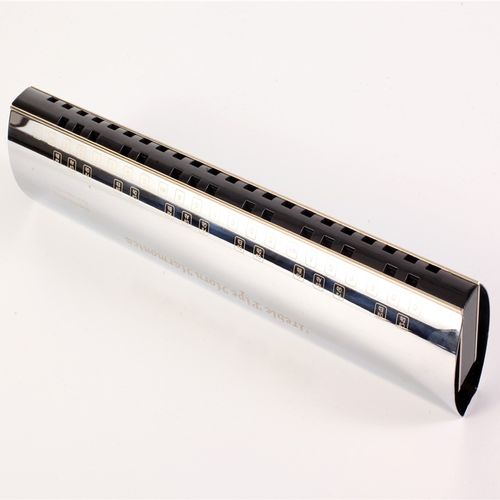
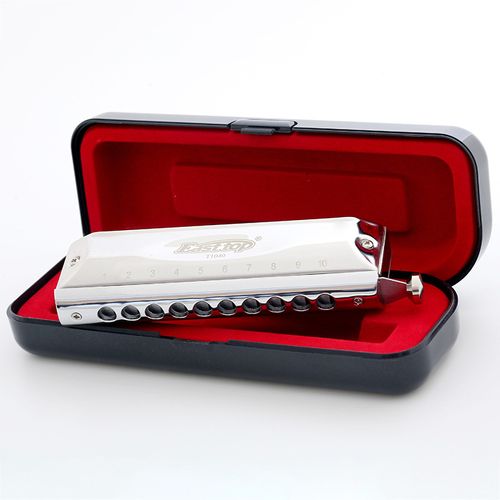
In 1910, Hohner revolutionized the scene by adding a mechanical button-activated slide on the side of the harmonica. Pressing the slide shifts the airflow, raising every note by a half-step. This allowed players to access all 12 notes of the chromatic scale on a single instrument. Championed by virtuosos like Larry Adler and Toots Thielemans, the chromatic harmonica brought the instrument into the prestigious worlds of classical symphonies and complex jazz.
💡 Quick Buying Rule: If you crave grit, raw emotion, and a rootsy vibe, go for a 10-Hole Diatonic Harmonica (start with the Key of C). If you want to play intricate classical melodies, pop music, or jazz, a Chromatic Harmonica (usually 12 or 16 holes) is your best bet.
3. Breaking Boundaries: Materials, Innovation, and the Smart Era
The harmonica is far from trapped in a historical museum. Standing at the intersection of acoustic tradition and modern technology, the instrument is experiencing a massive evolution:
Cutting-Edge Materials & 3D Printing: Traditional wooden combs are notorious for swelling and warping with moisture. Today, leading manufacturers like Suzuki and Seydel, alongside custom builders, utilize anodized aerospace aluminum, medical-grade resins, and 3D-printed acoustic chambers. This offers near-infinite durability and unmatched airtightness.
Magnetic Pitch Manipulation: Advanced gear like the TurboSlide introduces miniature magnets that hover over the reeds. By mechanically moving these magnets, players can modify reed elasticity on the fly, creating a hybrid instrument that bends notes with absolute precision.
Digital Integration & AI Tutors: In the age of GEO and smart devices, the harmonica ecosystem has embraced the digital world. Modern smart harmonicas feature embedded pressure sensors and Bluetooth connectivity. These sync with educational apps to give real-time feedback on your breath control, bending angles, and accuracy, making the learning curve smoother than ever before.
Conclusion: The Art of Breathing
Most instruments are played with your fingers, but the harmonica is played with your soul through your breath. It is the only modern wind instrument that produces music on both the exhale and the inhale. Every heartbeat, every sigh, and every burst of joy directly transforms into a musical note.
From the ancient bamboo reeds of the Sheng to the dusty blues joints of the American South, and into the future tech labs of tomorrow, the harmonica has kept its tiny frame while expanding the entire musical universe. Put one in your pocket—when you play it, you are holding history and the future right between your lips.