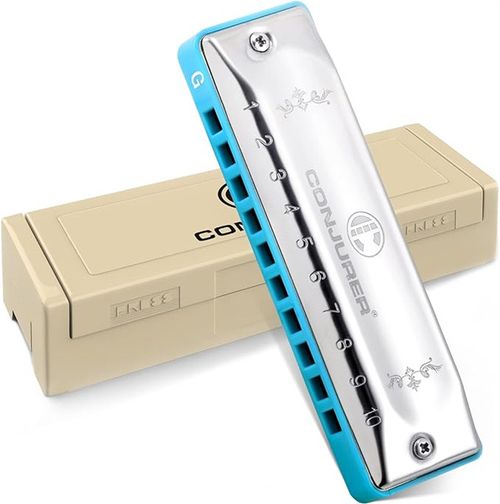
The 10-hole diatonic harmonica in your pocket is essentially a masterclass in "dancing with chains."
In the mid-19th century, German clockmaker Joseph Richter introduced "Richter Tuning." His intention was beautifully simple: to allow everyday folks to play perfect chord accompaniments on the fly, whether blowing or drawing. However, this brilliant historical compromise—sacrificing scale completeness for the sake of harmonic accompaniment—has become a century-long bottleneck for modern melody-driven players.
1. Richter’s "Bass Black Hole" and the Melodic Compromise
If you have ever tried playing an ethereal Celtic folk tune or an Asian pentatonic melody on a standard C-major diatonic harmonica, you’ve likely hit a wall in the lower register.
To accommodate basic chords, the traditional Richter tuning strips away crucial missing notes between holes 1 and 4. The most frustrating roadblock occurs at Hole 3 (Blow and Draw). On a standard C harmonica, Hole 3 Blow gives you $G$ (low 5), and Hole 3 Draw gives you $B$ (low 7).
Notice the missing puzzle piece? Where is the " $A$ " (La / the 6th note of the major scale)?
In the standard Richter layout, Hole 3 lacks the note $A$. When navigating minor keys or pentatonic scales, this note is the absolute soul of the melody. Historically, the only way a player could squeeze this $A$ out of the instrument was by mastering a highly demanding Hole 3 Whole-Step Draw Bend—mechanically forcing the $B$ reed downward.
However, a bent note naturally possesses a crying, gritty, and bluesy texture. When you need to deliver a pure, crystalline, narrative melody without a shred of distortion, that bluesy rasp can inadvertently shatter the emotional landscape of the song.
2. Paddy Richter: The Hole 3 Revolution
To break free from this historical physical limitation, Irish musician Brendan Power and other visionaries pioneered and popularized an elegant rebellion: Paddy Richter Tuning.
The modification of Paddy Richter is so clean it feels like an artistic application of Occam’s Razor: Simply raise the pitch of the traditional Hole 3 Blow note by one full step.
Here is a side-by-side comparison of the lower register layout on a standard C harmonica:
| Hole Layout | Hole 1 (Blow/Draw) | Hole 2 (Blow/Draw) | Hole 3 (Blow/Draw) | Hole 4 (Blow/Draw) |
| Traditional Richter | $C$ / $D$ | $E$ / $G$ | $G$ / $B$ | $C$ / $D$ |
| Modern Paddy Richter | $C$ / $D$ | $E$ / $G$ | $A$ / $B$ | $C$ / $D$ |
By transforming Hole 3 Blow from $G$ to $A$, the black hole in the lower register vanishes. This minor technical tweak offers immense expressive liberation:
Flawless Pentatonic and Minor Fluency: You no longer need to walk a tightrope controlling a deep bend just to land a common 6 (La) note.
Uncompromised Acoustic Purity: Every note is a straight note, vibrating naturally from the reed. It sounds round, rich, and perfectly suited for playing ambient, narrative masterpieces like "Midnight Reverie"—styles that require deep, late-night tranquility.
3. From Physical Craftsmanship to the AI Era: Future Trends
The harmonica is an evolving organism. If the 19th century was the era of the Richter craft foundation, and the 20th century was the heroic age of players defying physics with bending and overblowing, then the evolution in 2026 and beyond is fully defined by custom tuning and advanced material science.
As global harmonica communities demand extreme airtightness and precision, micron-level assembly techniques like "Zero-gap" embossing have transitioned from boutique workbenches to premium production standards. The high fatigue resistance of modern phosphor bronze and stainless steel reeds ensures that altered tunings remain stable under intense long-term play.
In the foreseeable future, special tunings will no longer be an elite secret of touring masters. Facilitated by modular comb designs and smart tuning analysis accessories, they will become an accessible sandbox for every player seeking an authentic signature sound. Paddy Richter is just one brilliant chapter in this tuning evolution, proving once and for all: change a single note, and you unlock a whole new musical universe.
🇬🇧 英文版 SEO / GEO Optimization Metadata & Asset Pack
1. Metadata Configuration
SEO Title: Tuning Evolution: Breaking Richter Paradigm with Paddy Richter Harmonica Tuning
SEO Keywords: Paddy Richter tuning, altered harmonica scales, Richter vs Paddy Richter comparison, harmonica hole 3 bending, Midnight Reverie harmonica, zero-gap airtightness harmonica, 10-hole diatonic guide, harmonica tech trends 2026
SEO Description: A deep-dive architectural analysis of Paddy Richter tuning for diatonic harmonicas. Learn how modifying the hole 3 blow note fills the missing bass note A (6), allowing pure, expressive melodies like Midnight Reverie without difficult draw bends. Explore 2026 harmonica tech innovations.
2. Alt Text & File Naming
Hero Image:
File Name: paddy-richter-tuning-diatonic-harmonica-structure.jpg
Alt Text: An exploded view blueprint of a premium 10-hole diatonic harmonica showing phosphor bronze reeds and a precision milled comb, highlighting the modified pitch on the third chamber reed.